
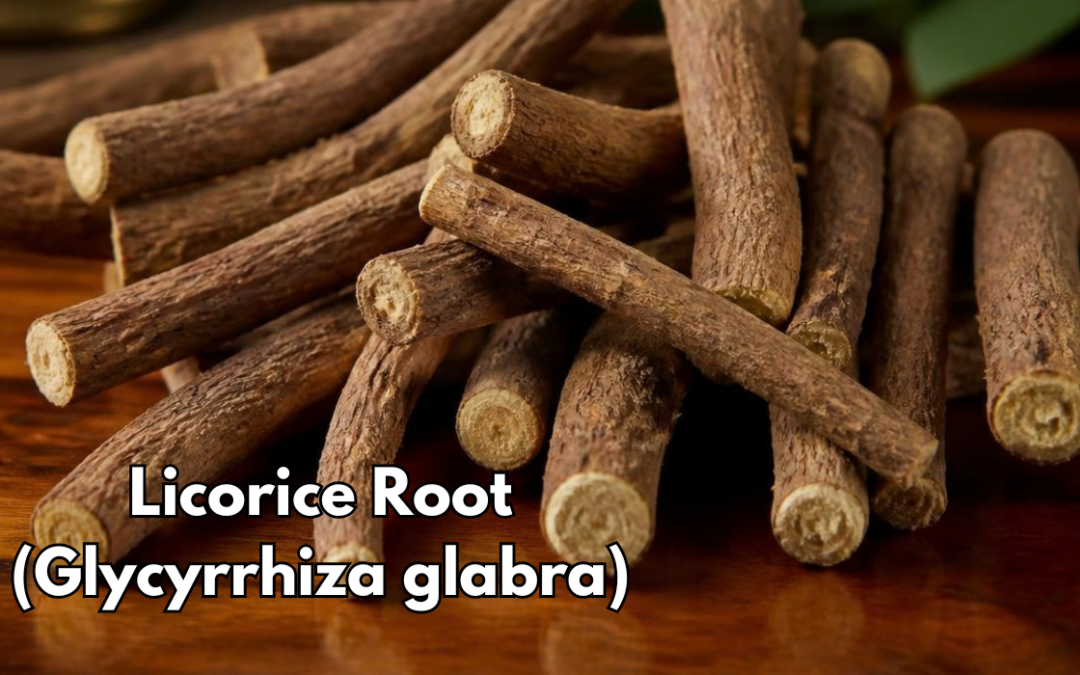
Welcome to our Ayurvedic Herbal Spotlight! Each month, we delve into seasonal herbs that can assist you in maintaining balance. We explore their medicinal actions, how they make you feel, their warming or cooling nature, and which doshas they benefit. Let’s enhance our well-being naturally!
Licorice Root (Glycyrrhiza glabra)
Known in Sanskrit as Yashtimadhu — literally “sweet stick” — Licorice Root is one of Ayurveda’s most beloved sweet-tasting herbs, prized for its ability to soothe, nourish, and heal irritated tissue throughout the body. A perennial herb with a long, fibrous root, Glycyrrhiza glabra has been used across Ayurvedic, Chinese, Greek, and Middle Eastern medical traditions for thousands of years, making it one of the most cross-culturally consistent herbs in the world’s healing systems.
Licorice works primarily on the respiratory and digestive tracts, where its sweet, unctuous, cooling qualities coat and calm inflamed or irritated mucous membranes. In Ayurveda, it is classified as kanthya (beneficial for the throat and voice), netrya (supportive of eye health), and balya (strength-promoting) — a gentle but deeply nourishing rejuvenative that stands apart from more stimulating or scraping herbs like Guggulu or Turmeric.
Medicinal Properties
Medicinal Actions: Demulcent · Expectorant · Anti-inflammatory · Adaptogen · Adrenal tonic · Antacid & GI-protective · Antitussive (cough-soothing) · Immunomodulator · Mild laxative · Rasayana (rejuvenative) · Kanthya (voice/throat tonic) · Netrya (eye tonic)
Nature: Cool, moist, sweet, heavy
How It Makes You Feel: Soothed, coated, and cushioned — both physically and emotionally. Licorice has a gentle, nurturing quality that many describe as calming to a raw or overstimulated system, whether that’s an irritated throat, an acidic stomach, or frayed nerves.
Recommended For: Primarily beneficial for Vata and Pitta; Kapha types should use it sparingly, as its heavy, sweet, moistening qualities can add to congestion or sluggishness if overused.
Licorice Root’s Key Medicinal Actions
- Demulcent & Respiratory Support Licorice’s best-known traditional use — its mucilage-rich, soothing quality coats and calms irritated mucous membranes throughout the throat and respiratory tract, making it a classic remedy for dry cough, sore throat, and hoarseness.
- Digestive & GI-Protective (Antacid) Traditionally used to soothe an irritated digestive lining, ease hyperacidity, and support the stomach’s natural protective mucous layer. Often included in formulas addressing acidity, heartburn, and general digestive inflammation.
- Adrenal Tonic & Adaptogen Long associated with supporting healthy adrenal function and the body’s resilience to stress. Traditionally used for fatigue and low vitality connected to prolonged stress, though this is also the action most closely tied to Licorice’s key precaution (see below).
- Anti-Inflammatory & Immunomodulator Used broadly to calm inflammation across tissues — respiratory, digestive, and skin — and traditionally regarded as supportive to healthy immune function, often included in formulas addressing recurring respiratory or digestive irritation.
- Rasayana, Voice & Eye Tonic Classified as kanthya (throat-nourishing) and netrya (eye-supportive), Licorice is traditionally used by singers, teachers, and public speakers to protect and strengthen the voice, and is included in formulas supporting healthy vision and eye tissue.
- Mild Laxative In larger doses, Licorice has a gentle laxative effect, traditionally used to ease constipation associated with dryness — particularly relevant for Vata-type constipation.
How Licorice Root Affects the Doshas
Vata — PACIFIES VATA
Licorice’s heavy, sweet, unctuous qualities directly counter Vata’s dryness, lightness, and depletion, making it one of the more nourishing and grounding herbs for a Vata constitution.
Recommendation: Helpful for dry cough, dry constipation, nervous exhaustion, and general depletion. Best taken with warm milk or ghee to amplify its nourishing effect.
Pitta — STRONGLY REDUCES PITTA
Licorice’s cooling, sweet nature is deeply Pitta-pacifying, soothing the heat and irritation that Pitta tends to generate in the digestive tract, skin, and emotions.
Recommendation: One of the best herbs for hyperacidity, heartburn, and inflammatory digestive conditions, as well as Pitta-driven irritability and a “burnt out” feeling. Often paired with Amalaki or Gotu Kola for added cooling support.
Kapha — MAY INCREASE KAPHA IN EXCESS
Licorice’s heavy, sweet, moistening qualities can add to Kapha’s natural tendency toward congestion, mucus, and sluggishness if used in large amounts or over a long period.
Recommendation: Use sparingly and combine with warming, decongesting herbs such as ginger or trikatu. Best avoided as a primary remedy for productive, mucus-heavy coughs, where a drying expectorant is usually more appropriate.
How to Use Licorice Root
As a powder (Churna): ¼–½ tsp mixed into warm water or honey, typically taken 1–2 times daily, often before meals for digestive support or before bed for respiratory and throat support.
As a decoction (Kashaya): Root simmered in water to make a soothing tea, traditionally sipped for sore throat, cough, or digestive irritation.
As a chewing stick or lozenge: The dried root can be chewed directly, or used in lozenge form, to soothe the throat and support vocal health — a traditional favorite among singers and public speakers.
As DGL (deglycyrrhizinated licorice): When the blood-pressure-related precautions below are a concern.
PRECAUTIONS: Not recommended for regular, high-dose, or long-term use in individuals with high blood pressure, kidney disease, or fluid retention/edema. May interact with blood pressure medications, diuretics, corticosteroids, and digoxin. Not recommended during pregnancy without practitioner guidance.
10/03/2026