
Welcome to our Ayurvedic Herbal Spotlight! Each month, we delve into seasonal herbs that can assist you in maintaining balance. We explore their medicinal actions, how they make you feel, their warming or cooling nature, and which doshas they benefit. Let’s enhance our well-being naturally!
Triphala (Three Fruits)
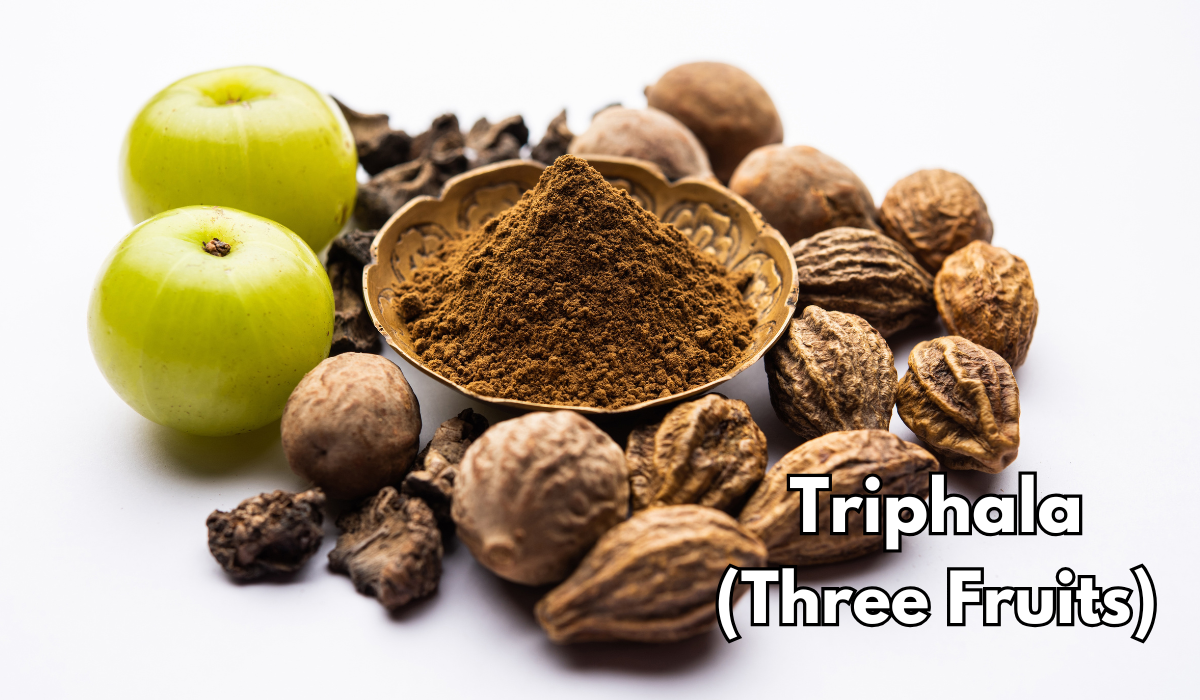
Triphala, meaning “three fruits” in Sanskrit, is perhaps the most trusted formula in the entire Ayurvedic pharmacy. It is not a single herb but a synergistic blend of three native Indian fruits — Amalaki (Emblica officinalis), Bibhitaki (Terminalia bellirica), and Haritaki (Terminalia chebula) — each contributing its own gifts while working together as a gentle, whole-body tonic. Where most herbs favor one dosha, Triphala is prized as tridoshic, meaning it can be taken safely and beneficially by nearly everyone, regardless of constitution.
Triphala works primarily on the digestive tract and rasa dhatu (the tissue layer governing nutrition and plasma), gently cleansing the colon, supporting regular elimination, and nourishing the tissues it purifies along the way. It is considered both a shodhana (cleansing) and rasayana (rejuvenating) formula — a rare combination that lets it detoxify without depleting. For this reason, it has earned a reputation as Ayurveda’s daily reset button, taken by millions each evening to support digestion, elimination, and long-term vitality.
Medicinal Properties
Medicinal Actions: Mild laxative · Digestive tonic · Detoxifier · Antioxidant · Anti-inflammatory · Antimicrobial · Rejuvenative (Rasayana) · Netra Rasayana (eye tonic) · Immune modulator · Colon cleanser · Metabolic support
Nature: Neutral, Tridoshic. Balanced across five of the six tastes (sour, sweet, pungent, bitter, astringent — only salty is absent)
How It Makes You Feel: Light, clear, and “cleaned out” — without the harsh urgency of a typical laxative. Regular users often describe steadier digestion, brighter skin, more regular elimination, and a subtle increase in overall energy as the body sheds accumulated toxins (ama).
Recommended For: All three doshas — Vata, Pitta, and Kapha — making it one of the few herbs suitable for daily, long-term use across constitutions.
Triphala’s Key Medicinal Actions
Gentle Detoxification & Elimination: Triphala’s most celebrated action is its ability to support regular bowel movements without the cramping or dependency associated with harsher laxatives. Haritaki tones the colon muscle, Bibhitaki scrapes away excess mucus and ama, and Amalaki nourishes the tissue being cleansed — together producing a balanced, non-habit-forming effect on elimination.
Digestive & Metabolic Support: Beyond its cleansing action, Triphala kindles agni (digestive fire) and improves nutrient absorption. It is traditionally used for bloating, sluggish digestion, and irregular appetite, helping the whole digestive system function more efficiently over time.
Antioxidant & Rejuvenative (Rasayana): Amalaki, one of the richest natural sources of vitamin C, gives Triphala a powerful antioxidant profile that helps neutralize free radicals and slow cellular aging. This rejuvenating quality is why Triphala has long been associated with longevity and vitality in classical Ayurvedic texts.
Immune Modulation & Anti-Inflammatory Action: Triphala supports a balanced immune response and helps calm systemic inflammation. By clearing ama — the toxic byproduct of poor digestion believed to underlie many chronic imbalances — it addresses one of the root causes Ayurveda considers central to immune dysfunction.
Netra Rasayana (Eye Health)L Triphala holds a special place in Ayurveda as a tonic for the eyes. A cooled infusion is traditionally used as an eyewash, and internal use is believed to support long-term eye health, clarity of vision, and reduced eye strain.
Skin & Complexion Support: As toxins are cleared from the gut, many people notice improvements in skin clarity and complexion. Triphala’s antioxidant and anti-inflammatory properties are thought to reduce the internal heat and impurities that often surface as skin irritation or dullness.
How Triphala Affects the Doshas
Vata – BALANCES VATA
Haritaki, the dominant fruit in most Triphala blends, is particularly grounding and tonifying for Vata. It supports peristalsis without over-stimulating a nervous system already prone to irregularity, easing constipation, gas, and the erratic digestion common to Vata types.
Recommendation: Best taken warm, mixed with a small amount of warm water or ghee in the evening, to support gentle, grounded elimination without aggravating Vata’s tendency toward dryness.
Pitta – BALANCES PITTA
Amalaki’s cooling, sour-yet-non-heating profile softens any warming effect from the other two fruits, making the overall formula soothing to Pitta’s fire. It helps cool inflammation in the digestive tract and calms the sharp, acidic digestion Pitta types often experience.
Recommendation: Take with cool (not iced) water, and favor Triphala blends higher in Amalaki. Especially useful for acid reflux, irritability, or any condition involving excess internal heat.
Kapha – BALANCES KAPHA
Bibhitaki’s light, drying, and mildly stimulating quality helps clear excess mucus and stagnation, addressing Kapha’s tendency toward sluggish digestion, and congestion. Triphala’s overall lightness makes it a natural ally for Kapha’s slower metabolism.
Recommendation: Take with warm water first thing in the morning on an empty stomach to stimulate digestion and counter Kapha’s characteristic morning heaviness. Blends higher in Bibhitaki and Haritaki are especially supportive.
Sources
Frawley, D. (2000). Ayurvedic Healing: A Comprehensive Guide. Lotus Press.
Glenn, Lori. (2018). Triphala. HerbalClip News, The Journal of the American Botanical Council. https://www.herbalgram.org/resources/herbclip/herbclip-news/2018/triphala/
Khasala, K. & Tierra, M. (2008). The Way of Ayurvedic Herbs. Lotus Press.
Verma, Dr. Deepak, et al. (2017). An Analysis of Triphala Powder With the Importance of Haritaki (Terminalia chebula) species: Ancient Miracle Formula. World Journal of Pharmaceutical Research, 6(10), 452-458. https://doi.org/10.20959/wjpr201710-9445
07/07/2026